Mobile Phone Technology
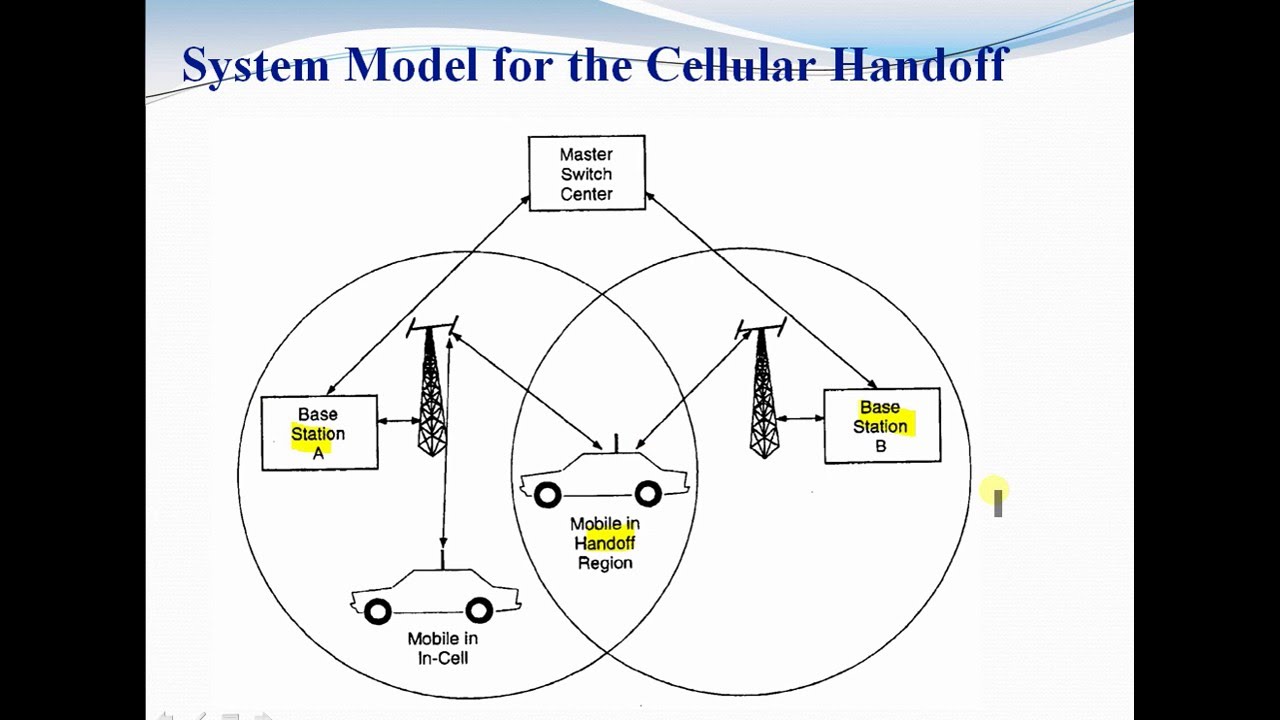
Handover and handoff are different words for the same idea.
The basic principle of mobile phone technology is that clients moving through the network wish to maintain continuous connection. As mobile phone technology is based on cell architecture, the client will move away from the influence of one cell and towards another as they move through the network. At some point, the client will be handed over from one cell to another.
If the subscriber is connected to the network but not sending or receiving a call or data, the handover will go unnoticed. However, if the subscriber is sending data and a handover occurs, one or more packets may be lost. This would just involve re-transmission, which is likely to go unnoticed by the client. However, if a client is in the middle of a phone call or real-time data transfer, there is a risk of losing the call or data, resulting in a break in transmission.
- We can classify a handover as either a hard or a soft handover.
- Soft Handover: A soft handover is a seamless handover in which the phone and network realise that the phone is moving away from the current cell and that there is a more powerful cell on the same network. The network moves the phone from one eNodeB to an adjacent one on the same network. Soft handover is the preferred method of swapping from one part of a network to another.
- Hard Handover: A hard handover is also known as a 'break before make' handover, meaning that the current connection is cut prior to the new connection being made. This may occur when the client has reached the edge of the current network and must switch to another network. The client is moved from one network provider to another (where network roaming is allowed), or from one generation to another (e.g. 4G to 2G).
- There are a number of different types and reasons for handover.
- For example, a subscriber may move closer to another eNodeB mast that is still controlled by the same Mobile Switching Centre (MSC).
- A subscriber moves out of the range of one MME (Mobile Management Entity) and into the range of another.
- When an eNodeB or MME becomes busy, the network attempts to balance demand by moving subscribers to a different eNodeB or MME.
- If a subscriber on a 4G network wishes to make a call but does not have access to VoLTE, they will be switched to a 2G network.
- While roaming internationally, a stronger network comes into range. For example, if a person is on holiday in France, they will be moved from one French mobile operator to another.
- In the UK, internal roaming would involve a hard handover.
deepl.com [AI] has been used to improve the text in this description
We may have started to use our mobile phones to make phone calls but now these devices are key to our modern society. We use our mobile phones for directions in a strange city; to access our money through our banking and credit card apps; for tickets to travel whether that is bus, train or air; to watch videos; to take images and buy stuff.
But how does mobile phone technology work? mobilephonetechnology.co.uk seeks to provide information about the technology behind the mobile phone in order to aid understanding and promote more realistic discussions about the technology. Understanding some of the basics of mobile phone technology will help explain how things work and what can and cannot be done with mobile phone technology.
mobilephonetechnology.co.uk is a FREE online resource. Have you found it interesting? You can say thank you and buy me a coffee here. Thank you very much.
w : mobilephonetechnology.co.uk
e :
 Blog
Blog
© mobilephonetechnology.co.uk all rights reserved 2017-2026