Mobile Phone Technology
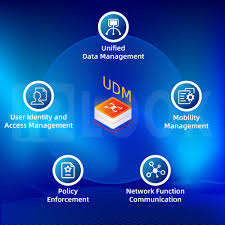
UDM with 5G
image ©IPLookIn a mobile phone system, it is necessary to store data on each subscriber. In a 2G system, this data is stored in the Home Location Register (HLR), in a 4G system it is stored in the Home Subscriber System (HSS), and in a 5G system it is stored in the Unified Database Management System (UDM).
The UDM is the main database that holds subscriber information. The key to this data is the International Subscriber Identity (ISN), which is the ' internationalised' version of the SIM card number. The database contains user profiles, location details and also authentication and authorisation details.
When a client device attempts to connect to the network, the network connects to the UDM to retrieve the user's authentication credentials and profile. This enables the network to verify the SIM's validity and determine which services the client is authorised to use. It also sets up and manages the session for the SIM across the network.
In 2G, a separate Visitor Location Register contains details of all clients connected to a particular mobile switching centre. This acts as a cache for the HLR for users on their home network, as well as containing details of others who have roamed onto the network. In 5G, the home user's details are stored in the AMF, alongside the session details in the SMF part of the UDM. These functions are implemented in the cloud and can be accessed quickly using edge computing. For a roaming device, the user's details are required for network access and are stored in the AMF and DSMF parts of the UDM.
- User Authentication: The UDM verifies that the client device can connect to the network and allows or denies access as appropriate, meaning that only authorised clients can connect to the network.
- Subscriber Profile Management: Storage of all user data, particularly which services the client is able to use.
- Location Information: This is the location of the client device, enabling the management of its mobility (handover) and ensuring the correct services are delivered.
- Authorization The authorisation process and 'keys' are managed in the UDM. This was initially held separately in a 2G system, but is unified in 4G/5G.
deepl.com [AI] has been used to improve the text in this description
We may have started to use our mobile phones to make phone calls but now these devices are key to our modern society. We use our mobile phones for directions in a strange city; to access our money through our banking and credit card apps; for tickets to travel whether that is bus, train or air; to watch videos; to take images and buy stuff.
But how does mobile phone technology work? mobilephonetechnology.co.uk seeks to provide information about the technology behind the mobile phone in order to aid understanding and promote more realistic discussions about the technology. Understanding some of the basics of mobile phone technology will help explain how things work and what can and cannot be done with mobile phone technology.
mobilephonetechnology.co.uk is a FREE online resource. Have you found it interesting? You can say thank you and buy me a coffee here. Thank you very much.
w : mobilephonetechnology.co.uk
e :
 Blog
Blog
© mobilephonetechnology.co.uk all rights reserved 2017-2026