Mobile Phone Technology
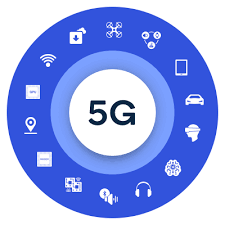 image ©Qualcomm
5G is the latest generation of mobile phone technology, succeeding 4G. It is envisaged that, in the initial phase, 5G will work alongside 4G prior to the implementation of a standalone 5G network. Even then, communication between the two networks should be 'seamless'. The aim of 5G is to provide low latency and high capacity. However, 5G is not just the next generation of mobile phone technology — it is so much more. The ITU defines three classes of 5G application:
- eMBB (enhanced Mobile Broadband), essentially a better 4G.
- mMTC (Massive Machine Type Communications), to provide a massive IoT communication medium.
- uRLLC (Ultra Reliable Low Latency Communication), to support real-time applications.
Two significant aspects of any mobile network are the radio access network (RAN) and the core. 5G is designed with virtualisation at its core, meaning that many radio and core network operations are virtualised and implemented on a cloud infrastructure. This makes things faster than a hardware-based, server-based network.
-
For 5G:
- RAN uses a new interface called 5G NR (New Radio). Within this, two standards are defined: FR1 and FR2.
- FR1 is an extension of existing networks utilising frequencies below 6 GHz. It supports macro-cells. In the UK, the 700 MHz and 3.4–3.8 GHz frequencies are currently used. These frequencies are similar to, and have the same qualities as, the frequencies currently used for 2G, 3G and 4G.
- FR2 uses mmWave frequencies operating between 24GHz and 100GHz. No mmWave frequencies have currently been released in the UK, although Ofcom has set out proposals to use 26 GHz and 40 GHz waves in the future. This standard will support small cells, typically arranged in clusters. No previous mobile network has used similar frequencies.
- The core is designed for better internet integration. Remember that, in 2G/3G, the primary connection was with the phone network; only 4G used the internet as the primary communication medium. Rather than servers, the core has been redesigned to embrace cloud systems, allowing more servers to be located nearby. Many of the previous network hardware functions have been replaced by network hardware virtualisation, i.e. software.
5G will support network slicing. This means that operators will be able to run virtual networks over their existing infrastructure, dedicating part of the spectrum to specific needs. For example, controlling autonomous vehicles requires different resources to viewing a 4K video. Different virtual networks will be available for purchase by large industrial businesses, perhaps not to the public.
4G provided some MIMO (multiple input, multiple output) technology. 5G uses this extensively in Massive MIMO. This enables data to be sent and received over multiple channels, achieving the necessary speed. Devices may use one or a few channels, but aggregation at the base station via the mast will support hundreds of channels.
Several radio technologies are used, including beamforming and beamsteering, to direct the antenna towards the user. Current general-purpose antennas usually work over a 120-degree sector to create the cells. This results in some capacity being directed towards open fields. Beamforming and beamsteering allow signals to be directed at users, and this can be done dynamically, in real time.
The ultra-high frequencies used in mmWave signals provide ultra-high capacity in urban areas, but many masts are needed, so mobile operators are seeking to attach them to street furniture to make 5G a ubiquitous urban network. A key feature of 5G technology is managing the interaction and handover between small cells and between small and macro cells.
deepl.com [AI] has been used to improve the text in this description
We may have started to use our mobile phones to make phone calls but now these devices are key to our modern society. We use our mobile phones for directions in a strange city; to access our money through our banking and credit card apps; for tickets to travel whether that is bus, train or air; to watch videos; to take images and buy stuff.
But how does mobile phone technology work? mobilephonetechnology.co.uk seeks to provide information about the technology behind the mobile phone in order to aid understanding and promote more realistic discussions about the technology. Understanding some of the basics of mobile phone technology will help explain how things work and what can and cannot be done with mobile phone technology.
mobilephonetechnology.co.uk is a FREE online resource. Have you found it interesting? You can say thank you and buy me a coffee here. Thank you very much.
w : mobilephonetechnology.co.uk
e :
 Blog
Blog
© mobilephonetechnology.co.uk all rights reserved 2017-2026